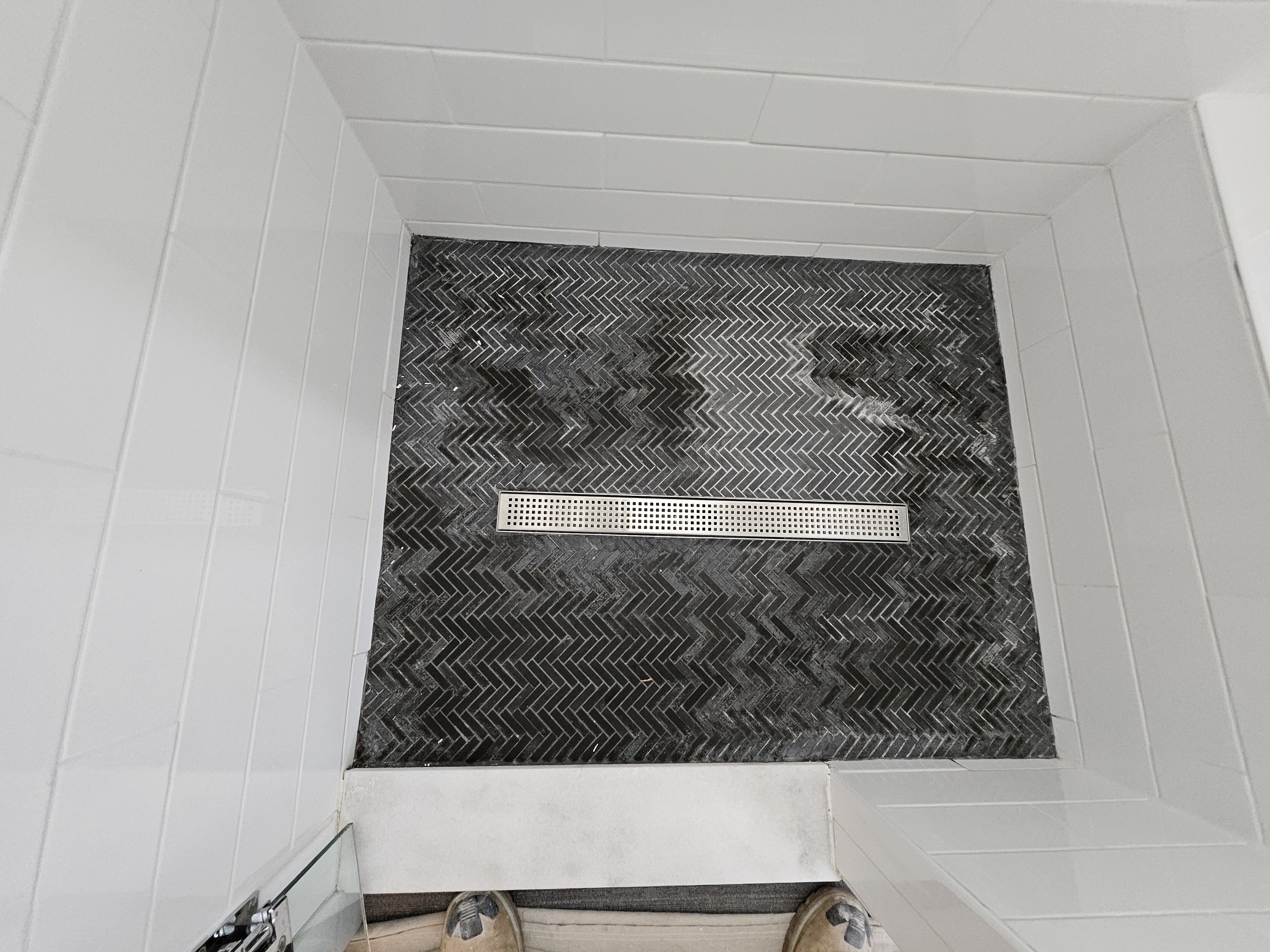
You scrub the grout. You bleach the corners. It looks clean for a week — and then the dark lines creep back in. If this sounds familiar, here's the hard truth: your mold problem probably isn't a cleaning problem. It's a waterproofing problem.
Mold Doesn't Live On Your Tile — It Lives Behind It
People assume mold grows on the surface of the grout. Sometimes it does. But the mold that keeps coming back is usually growing in the layers you can't see — the substrate, the wall board, or the old mortar bed behind the tile.
Here's the part most homeowners never get told: tile and grout are not waterproof. Grout is porous. Water passes through it every time you shower. In a properly built shower, a waterproofing membrane behind the tile catches that moisture and sends it to the drain. In a shower without one, that water soaks into whatever is back there and stays wet — warm, dark, and damp. Exactly what mold needs.
Surface Mold vs. Deep Mold — How to Tell
- Surface mold wipes away and stays gone for weeks. Usually a ventilation and habit issue — fixable.
- Deep mold comes back in the same spots within days, often along grout lines, inside-corner seams, or where the wall meets the floor. It may smell musty even when the shower looks clean. This is a sign moisture is trapped behind the tile.
If you're re-caulking the same corner every few months, that's not bad caulk. That's water finding its way behind a system that was never sealed properly.
Why You Can't Just Re-Grout Your Way Out of It
A homeowner notices mold, so they regrout, recaulk, maybe replace a few tiles. It looks great for a season. Then it's back — because the failure was never the grout. It was the missing or failed waterproofing underneath. A real fix means addressing the layer behind the tile: a bonded waterproofing membrane like the Schluter KERDI system, installed behind the tile with sealed seams at every corner, drain, and change of plane. Done right, water never reaches anything that can grow mold.
What Homeowners Can Actually Do
- Run your exhaust fan during every shower and for 20–30 minutes after.
- Squeegee the walls after showering — thirty seconds removes most standing water.
- Keep grout sealed with a penetrating sealer (helps, but is not a substitute for proper waterproofing).
- Replace failing caulk promptly — but if it keeps failing, treat it as a warning sign.
The Bottom Line
Surface mold is a maintenance issue. Mold that won't quit is almost always a sign that water is getting somewhere it shouldn't — and no amount of scrubbing fixes a waterproofing failure. If you've cleaned, regrouted, and recaulked and the mold still comes back, have the system itself looked at before spending more money treating the symptom.